In brief: the question is not whether you run models locally or in the cloud, but for which stage of work. Training on large datasets remains the cloud’s job. Daily prototyping and processing your own data, especially data that may not leave the company, usually ends up cheaper and simpler on a dedicated workstation.
What we are actually comparing
Rented GPU hours mean compute capacity paid by the minute or hour, started when you need it and stopped afterwards. The unit cost is known, the monthly cost is not, because it depends on how much you use.
A local workstation means equipment bought once, permanently available, with a cost that does not rise however much you use it. The monthly cost is predictable, the initial investment is not.
The essential difference is not between cheap and expensive. It is between an expense that grows with usage and one that does not grow at all.
How to work out the break-even point
The calculation is simple and worth doing before any technical discussion. Estimate how many hours a month you would actually use the compute, multiply by the provider’s hourly rate, and compare against the workstation depreciated over four years, plus electricity and administration time.
The rule that almost always emerges is this: if the equipment would be powered on and busy for most of the working day, local wins. If you need intensive compute a few days a month, renting wins comfortably. Do not use prices found online, ask for real rates for the configuration you need, because the differences between providers are large.
When local is worth it
- The data may not leave. Personal data, personnel files, projects under confidentiality agreements, customers’ technical documentation. If processing stays on site, some of the legal questions disappear.
- Daily, constant work. A team iterating every day consumes hours you pay for every time in the cloud.
- Fast iteration. No uploading datasets for every run and no waiting for resources to be allocated.
- Predictable costs. No surprise invoice after a week in which someone left a resource running.
- Work without a good connection, or in places where the link is unreliable, such as production halls and laboratories.
When renting is worth it
- Training on large datasets. Here the cloud has no reasonable competition for a small company.
- Short, rare peaks. You pay exactly what you consume, without buying for the peak.
- Needing the latest hardware for a short time, without tying yourself to one generation of equipment.
- Very large models that simply do not fit in a workstation’s memory.
- Distributed teams that need the same resource from different places.
The real constraint is memory, not speed
The most common surprise on a first purchase is that a model does not start at all, rather than running slowly. What you can run locally depends first of all on how much of the model fits in the memory available for computation. Speed decides how long you wait, memory decides whether there is anything to wait for.
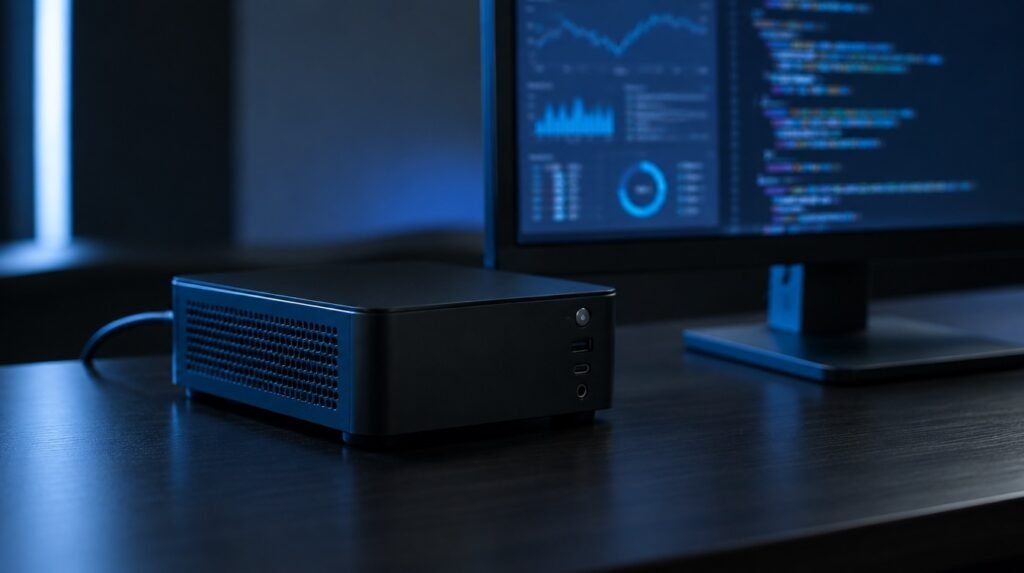
That is why sizing starts from the question “which model has to fit”, not from the available budget. The specifications of the workstation we propose for this kind of work are on the Dell Pro Max with GB10 page.
The confidentiality side
Sending data to an external service is processing, with everything that follows: a legal basis, informing the people concerned, a contract with the provider, checking where the data ends up. For many companies the question is not what an hour of compute costs, but whether they are allowed to send the material there at all.
Local processing does not remove the obligations, but it removes some of them and simplifies the conversation with customers who impose contractual conditions about their data. We wrote at length about the division of responsibility in the article on private and public cloud, and for companies within the scope of NIS2, managing supplier-related risk is itself a required measure.
What a local workstation does not solve
- It does not replace the largest models available as a service. For many tasks that is not needed, but the expectation has to be right.
- It does not exempt you from internal rules about which data is used and who may see the results.
- It needs administration: updates, drivers, backup, hardening. It is a server, not a coffee machine.
- It ages. Hardware generations change quickly, and depreciation over four years is an assumption rather than a guarantee.
Five questions that decide it
- What data are you processing, and is it allowed to leave the company?
- Which stage are you at: experimenting, or running something stable every day?
- How many hours a month would the equipment actually be busy?
- Which model has to fit, now and in a year?
- Who administers the equipment and who answers if it stops?
If you have no answer to the first three, renting for a few months is the prudent decision. You will learn your real consumption and buy knowing what you need.
What we do
PRO IT sizes the equipment starting from what you want to run, delivers and installs it as a Dell Technologies Gold Partner, integrates it into the network and the backup, and keeps it under maintenance like any other server. We do not sell compute hours, so we have no interest in pushing you one way or the other.
If you do not yet know what you need, tell us what you want to achieve and what data you work with. Sizing starts from there.